
Tim Penjaga Hutan (TPH) Mantaren I melakukan patroli rutin di kawasan gambut Hutan Desa Mantaren I, Kecamatan Kahayan Hilir, Kabupaten Pulang Pisau, Kalimantan Tengah. Patroli dilakukan dengan berjalan kaki menyusuri jalur gambut dan tepian sungai kecil di dalam kawasan hutan desa untuk memantau kondisi kawasan sekaligus mengidentifikasi tanda-tanda keberadaan satwa liar.
Perjalanan dimulai dari area bekas kebakaran yang masih menyisakan hamparan tanah hitam dan vegetasi terbuka. Di tengah udara yang terasa panas dan sengatan matahari, hal itu tidak menyurutkan langkah patroli menapaki gambut basah, lunak, dan tidak stabil di areal hutan desa. Semak belukar tumbuh jarang, sementara batang-batang kayu bekas terbakar masih tampak berdiri di sepanjang jalur patroli.
Sekitar dua jam perjalanan memasuki kawasan dengan tutupan pohon yang lebih rapat, suasana mulai berubah. Kanopi pohon menahan cahaya matahari sehingga udara terasa lebih sejuk. Pohon jelutung, geronggang, blangiran, dan tumih tumbuh mendominasi lanskap gambut. Suara burung terdengar dari sela pepohonan, sementara genangan air kecil dan akar-akar gambut membentuk jalur alami yang harus dilewati tim patroli.
Di tengah patroli, saat menyusuri tepian aliran sungai kecil di dalam kawasan hutan, TPH Mantaren I berhenti sejenak. Mata mereka tertuju pada sarang orangutan di dahan tinggi di atas kanopi. Struktur sarang tampak jelas berupa anyaman ranting dan daun yang masih segar berwarna hijau. Posisi sarang yang berada tidak jauh dari aliran air dan dikelilingi vegetasi rapat menunjukkan kawasan tersebut masih menjadi ruang hidup satwa arboreal, yaitu satwa yang sebagian besar hidup, bergerak, mencari makan, dan beraktivitas di atas pepohonan. Orangutan termasuk satwa arboreal yang sangat bergantung pada tutupan hutan dan pohon-pohon besar untuk bertahan hidup. “Sarang orangutan masih terlihat baru,” ujar Ganti, anggota TPH Mantaren I sambil menunjuk ke arah dahan pohon.
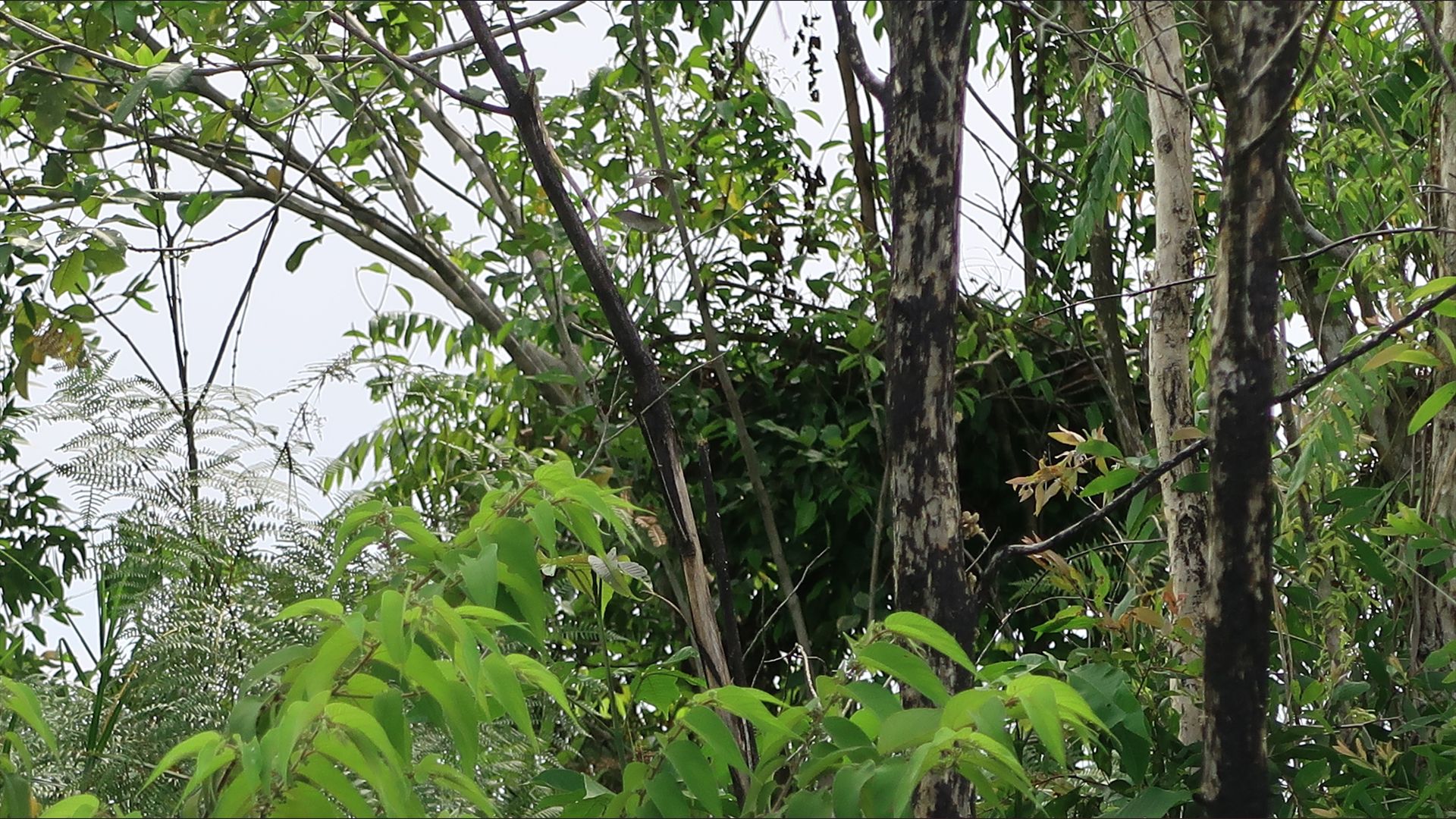
Sarang Orang Utan temuan tim patroli. Sumber foto: KPSHK.
Tim patroli kemudian berhenti untuk mendokumentasikan temuan tersebut. Lokasi sarang dicatat dan ditandai menggunakan titik koordinat sebagai bagian dari monitoring dan identifikasi satwa liar di kawasan Hutan Desa Mantaren I.
Patroli kemudian dilanjutkan sekitar dua kilometer lebih dalam memasuki kawasan gambut. Jalur yang dilewati semakin berat karena kondisi tanah berlumpur dan tergenang air di beberapa titik. Di area gambut basah dekat genangan kecil, langkah kaki mereka kembali terhenti. Anggota tim dengan cermat mengamati jejak kaki rusa yang tercetak jelas pada permukaan tanah. Bentuk tapak yang masih utuh menunjukkan jejak tersebut tergolong baru.
Temuan jejak rusa itu pun didokumentasikan. Titik lokasi penemuan dicatat sebagai bagian dari pemantauan rutin keberadaan satwa di dalam kawasan hutan desa. Bagi TPH, dari tanda-tanda yang mereka temukan, seperti sarang orangutan, tapak rusa, dan suara burung, membuat mereka meyakini bahwa kawasan tersebut masih menjadi ruang hidup satwa liar. Dengan demikian, area Hutan Desa Mantaren I masih menyediakan sumber pakan bagi satwa yang ada.
Patroli rutin yang dilakukan TPH tidak hanya bertujuan menjaga kawasan dari ancaman kebakaran, pencurian kayu, dan pengrusakan hutan. Mereka juga memastikan kehidupan satwa liar tetap bertahan di dalam ekosistem gambut. “Kadang kami menemukan jejak baru atau suara satwa di lokasi yang berbeda. Itu tanda hutan masih hidup,” ujar Weli, anggota TPH Mantaren I.
Bagi masyarakat dan tim penjaga hutan, menjaga biodiversitas berarti menjaga jejaring kehidupan yang saling terhubung di dalam gambut. Selama jejak-jejak kehidupan itu masih ditemukan di Mantaren I, hutan gambut tetap memiliki kesempatan untuk terus hidup, pulih, dan menopang kehidupan manusia maupun satwa liar di sekitarnya.
Penulis: Alma
Editor: JW & Kiss
The Mantaren I Forest Ranger Team (TPH) conducted routine patrols in the peatland area of the Mantaren I Village Forest, Kahayan Hilir District, Pulang Pisau Regency, Central Kalimantan. The patrols were conducted on foot along peat paths and small riverbanks within the village forest to monitor the area’s condition and identify signs of wildlife.
The journey began in a burnt area that still left behind expanses of black soil and exposed vegetation. Despite the hot air and scorching sun, this did not deter the patrol from traversing the wet, soft, and unstable peat of the village forest. Undergrowth was sparse, while burnt logs still stood along the patrol path.
About two hours into the denser tree cover, the atmosphere began to change. The tree canopy blocked the sunlight, making the air cooler. Jelutung, geronggang, blangiran, and tumih trees dominated the peatland landscape. Bird calls could be heard from between the trees, while small puddles and peat roots formed natural paths for the patrol team to navigate.
In the middle of a patrol, while following the banks of a small river within the forest area, the Mantaren I Village Forestry Team (TPH Mantaren I) paused. Their eyes fell on an orangutan nest on a branch high above the canopy. The nest’s structure was clearly visible, woven from fresh green twigs and leaves. The nest’s location, not far from the water flow and surrounded by dense vegetation, indicated that the area was still home to arboreal animals, meaning they live, move, forage, and perform their activities in trees. Orangutans are arboreal animals that rely heavily on forest cover and large trees for survival. “The orangutan nest still looks fresh,” said Ganti, a member of the TPH Mantaren I, pointing to a tree branch.
Orangutan nest discovered by the patrol team. Photo source: KPSHK.
The patrol team then stopped to document the discovery. The nest’s location was recorded and marked using coordinates as part of the monitoring and identification of wildlife in the Mantaren I Village Forest area.
The patrol then continued for about two kilometers deeper into the peatland. The path became increasingly difficult due to muddy and waterlogged soil in several spots. In a wet peat area near a small puddle, their footsteps halted again. Team members carefully examined the deer footprints clearly imprinted on the ground. The intact footprints indicated that they were relatively recent.
The deer tracks were documented. The location of the discovery was recorded as part of routine wildlife monitoring within the village forest area. The TPH (Targeted Forest Rangers), based on the signs they found, such as orangutan nests, deer tracks, and bird calls, convinced them that the area was still a habitat for wildlife. Therefore, the Mantaren I Village Forest area still provides a food source for the animals.
The TPH’s routine patrols not only aim to protect the area from fires, logging, and forest destruction, but also to ensure that wildlife survives within the peat ecosystem. “Sometimes we find new tracks or animal sounds in different locations. That’s a sign that the forest is still alive,” said Weli, a member of the Mantaren I TPH.
For the community and the forest rangers, preserving biodiversity means maintaining the interconnected web of life within the peat. As long as traces of life are still found in Mantaren I, the peat forest has the opportunity to continue to thrive, recover, and support the lives of humans and wildlife.
Author: Alma
Editor: JW & Kiss
Add a Comment