
Pagi itu desiran angin yang mengalir menerpa pohon-pohon di hutan Kahayan Hilir, membisikkan semangat peserta Focus Group Discussion (FGD). Mereka bertekad melahirkan langkah nyata membangun masa depan yang harmonis antara kebutuhan ekonomi dan kelestarian ekosistem gambut. FGD yang berlangsung di Palangka Raya, 14-15 November 2024 mengusung tema, “Sinergi Rencana Kelola Perhutanan Sosial (RKPS) dan Pengelolaan Terpadu Ekosistem Hutan Gambut (PTEHG)”.
Sejak tahun 2019, masyarakat desa di Kahayan Hilir telah mengusung visi melalui Rencana Kelola Perhutanan Sosial (RKPS). RKPS menjadi panduan dan arahan masyarakat lokal dalam mengelola hutan dengan prinsip-prinsip; berkelanjutan, rencana konservasi, pemanfaatan hasil hutan, dan pengembangan ekonomi kreatif berbasis sumber daya alam lokal. “Dokumen RKPS bukan sekadar catatan, tetapi harapan yang hidup di tengah hutan,” ungkap Aftrinal (49), Project Manager Program PTEHG K.P.SHK.
Menurut Aftrinal, tiap lembar dokumen Rencana Kerja Perhutanan Sosial (RKPS) menyimpan kisah dan impian para pejuang hutan di desa-desa seperti Buntoi, Gohong, dan Kalawa. Namun, perjuangan mereka bukan hanya soal melindungi hutan, melainkan juga tentang memahami pentingnya ekosistem gambut. “Ekosistem ini adalah jantung kehidupan kami, dan RKPS adalah panduan untuk menjaganya,” ujar Aftrinal.
Keselarasan RKPS dengan Program Pengelolaan Terpadu Ekosistem Hutan Gambut (PTEHG) menjadi sorotan utama dalam sebuah diskusi kelompok terfokus (FGD) yang menghadirkan KPSHK, Lembaga Pengelola Hutan Desa (LPHD), dan para ahli kehutanan. PTEHG sendiri mempunyai tiga pilar utama: kelola kelembagaan, kelola kawasan, dan kelola usaha ekonomi. Program ini mencakup empat aspek utama, yakni penguatan kelembagaan, penataan kawasan, pemulihan ekosistem, serta peningkatan kapasitas dan usaha masyarakat.
“Mengintegrasikan dua dokumen besar ini seperti jalinan masa depan,” kata Penyang D. Sandan (55), salah satu narasumber FGD. Menurutnya, sinergi ini menghadirkan keseimbangan antara pemanfaatan ekonomi dan konservasi. Ia menambahkan, “RKPS memberi arahan, sementara PTEHG menyediakan fondasi untuk implementasi yang lebih terstruktur”.
Diskusi dalam FGD berlangsung intens. Berbagai tantangan dibahas, mulai dari menjaga keutuhan hutan hingga membangun kesejahteraan masyarakat secara berkelanjutan. Yusuf Aguswan, salah satu narasumber, menyampaikan bahwa integrasi ini merupakan wujud nyata kolaborasi manusia dan alam. “Kahayan Hilir bukan sekedar wilayah. Ini adalah rumah bagi ribuan spesies flora, fauna, dan manusia yang hidup dari kelestariannya,” jelas Yusuf. Ia juga menekankan pentingnya peningkatan kapasitas kelembagaan hingga pemanfaatan jasa lingkungan. “Setiap peserta saling berbagi wawasan untuk mengatasi tantangan dalam mengelola ekosistem gambut,” tambahnya.
Di penghujung FGD, ada sebuah harapan yang mengalir di udara Kahayan Hilir. Harapan bahwa setiap helai daun, setiap aliran air, dan setiap embusan angin di hutan gambut ini akan terus memberi kehidupan. Bukan hanya untuk hari ini, tetapi untuk anak cucu yang kelak akan merasakan hutan sebagai warisan tak ternilai.
Penulis: Alma
Editor: JW dan Kis
That morning, the breeze rustling through the trees in the Kahayan Hilir forest inspired the enthusiasm of the Focus Group Discussion (FGD) participants. They were determined to take concrete steps to build a future that harmonizes economic needs and the sustainability of peat ecosystems. The FGD, held in Palangka Raya on November 14-15, 2024, carried the theme, “Synergy of the Social Forestry Management Plan (RKPS) and Integrated Management of Peat Forest Ecosystems (PTEHG).”
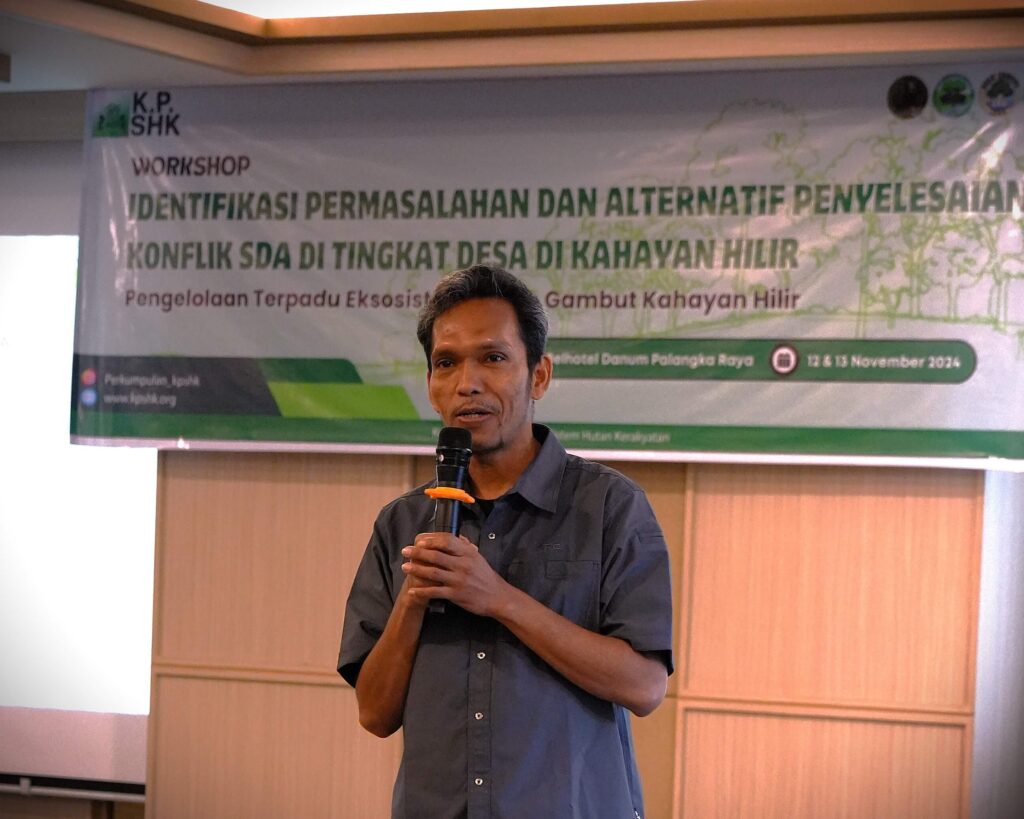
Aftrinal Sya’af Lubis (49), Project Manager of the PTEHG K.P.SHK Program at the first FGD “Identification of Problems and Alternatives for Resolving Natural Resource Conflicts at the Village Level in Kahayan Hilir”, Palangka Raya, November 12, 2024. Photo Source: Bayu_K.P.SHK.
Since 2019, the village community in Kahayan Hilir has been promoting a vision through the Social Forestry Management Plan (RKPS). The RKPS serves as a guide and direction for local communities in managing forests based on the principles of sustainability, conservation planning, utilization of forest products, and development of a creative economy based on local natural resources. “The RKPS document is not just a record, but a hope that lives in the forest,” said Aftrinal (49), Project Manager of the PTEHG K.P.SHK Program.
According to Aftrinal, each page of the Social Forestry Work Plan (RKPS) document holds the stories and dreams of forest defenders in villages like Buntoi, Gohong, and Kalawa. However, their struggle is not only about protecting the forest, but also about understanding the importance of peat ecosystems. “This ecosystem is the heart of our lives, and the RKPS is a guide to preserving it,” Aftrinal said.
The alignment of the RKPS with the Integrated Peat Forest Ecosystem Management Program (PTEHG) was a major highlight in a focus group discussion (FGD) featuring the KPSHK (Community Forest Management Agency), Village Forest Management Institutions (LPHD), and forestry experts. The PTEHG itself has three main pillars: institutional management, area management, and economic enterprise management. This program encompasses four main aspects: institutional strengthening, area planning, ecosystem restoration, and community capacity and enterprise development.
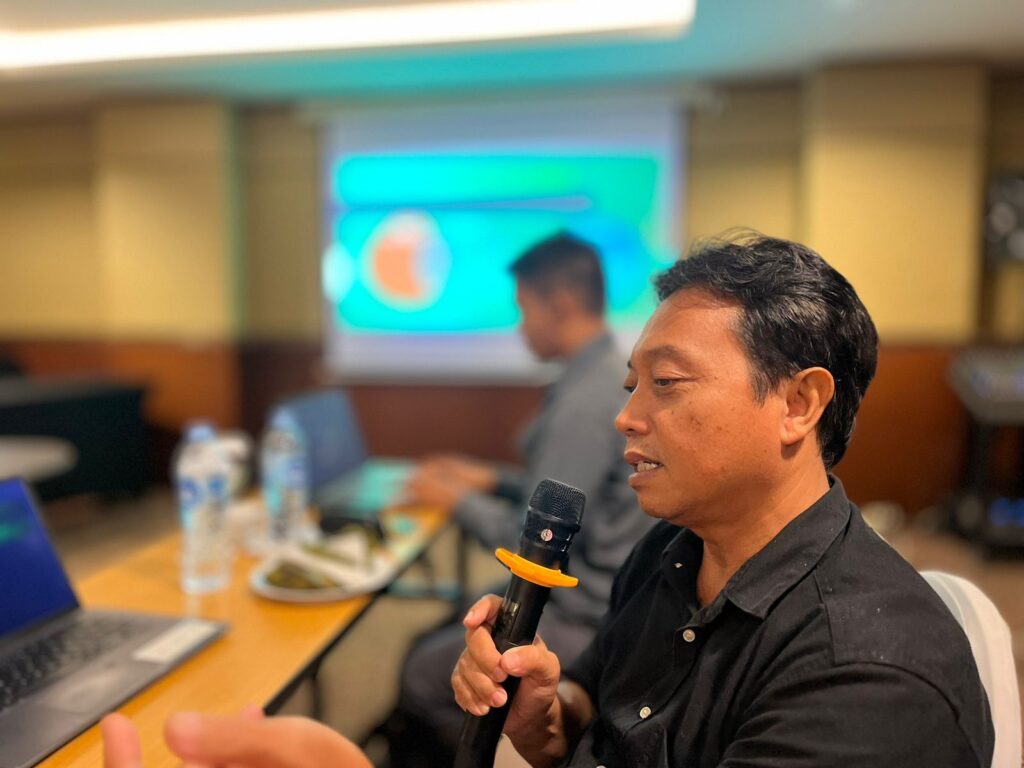
Penyang D. Sandan (55), Resource Person for the second FGD “Synergy of Social Forestry Management Plans (RKPS) and Integrated Management of Peat Forest Ecosystems (PTEHG)”, Palangka Raya, 14 November 2024. Photo Source: Oeban_K.P.SHK.
“Integrating these two major documents is like weaving the future,” said Penyang D. Sandan (55), one of the FGD speakers. According to him, this synergy creates a balance between economic utilization and conservation. He added, “The RKPS provides direction, while the PTEHG provides the foundation for more structured implementation.”
The FGD discussion was intense. Various challenges were discussed, from maintaining forest integrity to building sustainable community welfare. Yusuf Aguswan, one of the speakers, conveyed that this integration is a concrete manifestation of collaboration between humans and nature. “Kahayan Hilir is not just a region. It is home to thousands of species of flora and fauna, and humans who thrive on its sustainability,” Yusuf explained. He also emphasized the importance of increasing institutional capacity and utilizing environmental services. “Each participant shared insights to overcome the challenges of managing peat ecosystems,” he added.
At the end of the FGD, there was a sense of hope in the air of Kahayan Hilir. The hope that every leaf, every stream, and every gust of wind in this peat forest will continue to provide life. Not only for today, but for children and grandchildren who will one day experience the forest as an invaluable heritage.
Author: Alma
Editor: JW and Kis
Add a Comment