
Cairan keemasan berwarna lebih gelap itu menetes perlahan tidak terlalu kental, cenderung lebih cair dibanding madu pada umumnya. Kilauannya pekat, seolah menyimpan kekuatan alami di dalamnya. Rasa yang ditinggalkan di lidah pun unik dengan sentuhan asam segar yang ringan. Dalam kotak-kotak kayu sederhana, lebah kelulut jenis trigona bekerja tanpa sengat, bergerak lincah di antara kantong-kantong madu kecil yang menggantung seperti butiran anggur.
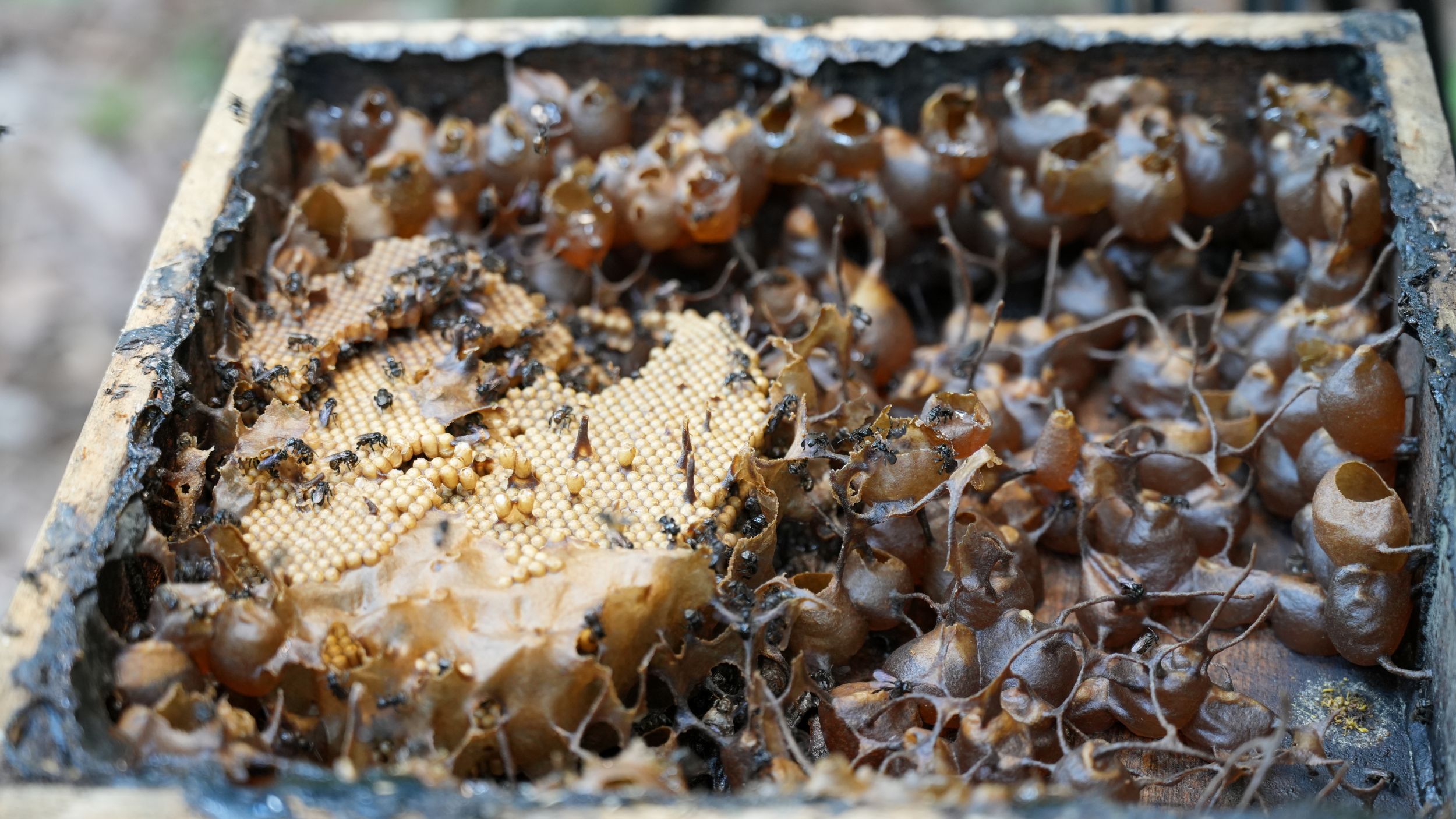
Sarang Madu Kelulut. Sumber Foto: KPSHK.
Pagi hari menjadi waktu yang dinanti oleh Kelompok Usaha Perhutanan Sosial (KUPS) Madu di bawah naungan Lembaga Pengelola Hutan Desa (LPHD) Buntoi. Panen madu kelulut bukan sekadar aktivitas ekonomi, tetapi juga perayaan kecil atas hubungan manusia dengan alam yang tetap terjaga.
Proses panen berlangsung sederhana. Tanpa alat rumit, cairan madu diambil perlahan menggunakan alat suntik khusus agar kantong madu tetap utuh dan lebah tidak terganggu. Cara ini menjaga keberlanjutan produksi sekaligus memastikan kualitas madu tetap alami.
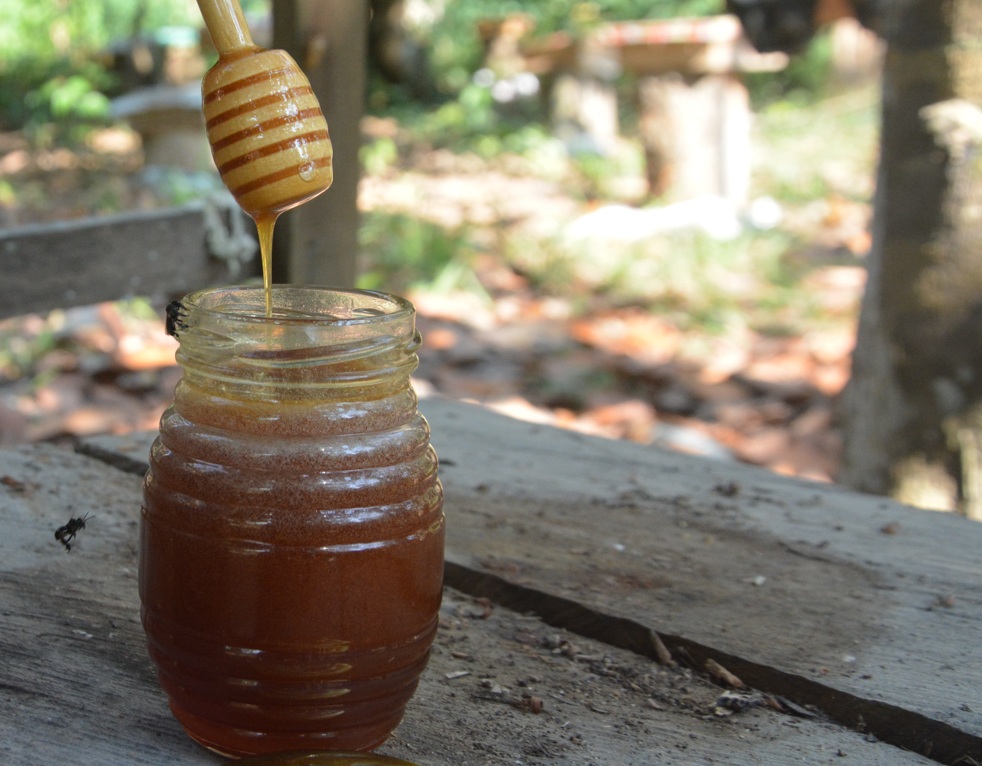
Madu Kelulut hasil panen. Sumber Foto: KPSHK.
Melyasie, salah satu pengurus KUPS madu, menceritakan bagaimana kegiatan ini berkembang menjadi sumber harapan baru bagi masyarakat. “Awalnya kami coba-coba, belajar dari pengalaman dan berbagi pengetahuan. Sekarang, madu kelulut sudah jadi salah satu sumber penghasilan yang cukup membantu,” ujarnya sambil tersenyum.
Lebah trigona yang digunakan memiliki karakter unik. Koloni tidak sepenuhnya dibudidayakan seperti lebah madu biasa. Stup atau kotak hanya menjadi tempat tinggal yang disiapkan, sementara keberadaan lebah sangat bergantung pada kondisi lingkungan sekitar. Artinya, keberhasilan panen tidak hanya ditentukan oleh teknik, tetapi juga oleh kesehatan ekosistem hutan.
Kondisi ini membuat KUPS madu sangat bergantung pada kelestarian alam. Ketika hutan tetap terjaga, sumber pakan melimpah dan lebah bertahan. Sebaliknya, gangguan seperti kebakaran hutan dan asap dapat berdampak besar.
Salumbu, Ketua KUPS, menjelaskan kekhawatiran itu dengan tegas. “Kalau ada kebakaran dan asap, lebah bisa pergi. Walaupun ada stup, mereka tidak akan tinggal kalau lingkungannya terganggu. Jadi menjaga hutan itu bukan pilihan, tapi kebutuhan,” ungkapnya.
Asap dari kebakaran tidak hanya mengganggu aktivitas lebah, tetapi juga bisa mengusir koloni trigona dari area budidaya. Kehilangan lebah berarti kehilangan produksi madu, sekaligus hilangnya sumber penghidupan masyarakat.
Kesadaran menjaga hutan tumbuh seiring dengan manfaat yang dirasakan langsung. Lebah kelulut membutuhkan lingkungan yang bersih dan beragam tanaman berbunga. Hubungan saling bergantung ini menjadi pengingat bahwa usaha ekonomi berbasis hutan hanya bisa bertahan jika alam tetap lestari.
Khasiat madu kelulut juga semakin dikenal luas. Warna yang lebih gelap sering dikaitkan dengan kandungan antioksidan yang tinggi, menjadikannya banyak dicari sebagai alternatif obat alami. Teksturnya yang lebih cair membuatnya mudah dikonsumsi, sementara rasa asam segar memberi sensasi berbeda dibanding madu biasa.
Salah satu pembeli, Rina, mengaku rutin mengonsumsi madu kelulut untuk menjaga daya tahan tubuh. “Rasanya memang beda, agak asam tapi segar. Biasanya saya minum tiap pagi, badan terasa lebih fit,” tuturnya.
Cerita lain datang dari Andi, mahasiswa Universitas Palangka Raya (UPR), pelanggan yang membeli madu untuk orang tuanya. “Orang tua saya lebih cocok pakai madu kelulut. Katanya lebih ringan di tenggorokan dan membantu pemulihan,” katanya.
Kepercayaan konsumen menjadi energi tambahan bagi KUPS madu LPHD Buntoi untuk terus berkembang. Produk yang dihasilkan bukan hanya soal kualitas, tetapi juga cerita tentang proses yang jujur dan alam yang dijaga.
Langkah kecil yang dilakukan kelompok ini membuktikan bahwa hutan tidak harus ditebang untuk memberi manfaat. Madu kelulut menjadi simbol bahwa keseimbangan antara ekonomi dan ekologi bukan sekadar wacana, melainkan sesuatu yang nyata dan bisa dirasakan.
Dengung lebah trigona di Buntoi hari ini bukan hanya suara alam, tetapi juga tanda kehidupan yang terus tumbuh pelan, konsisten, dan penuh harapan.
Penulis: Alma
Editor: JW
The darker golden liquid drips slowly, not too thick, tends to be more liquid than honey in general. The luster was dense, as if it held natural power within it. The taste left on the tongue is unique with a light touch of fresh sourness. In simple wooden boxes, trigona kelulut bees work without stingers, moving nimbly between small honey bags that hang like grapes.
Kelulut Honeycomb. Photo Source: KPSHK.
Morning is the time awaited by the Madu Social Forestry Business Group (KUPS) under the auspices of the Buntoi Village Forest Management Institute (LPHD). Kelulut honey harvest is not just an economic activity, but also a small celebration of the maintained human relationship with nature.
The harvesting process is simple. Without complicated equipment, the liquid honey is drawn slowly using a special syringe so that the honey bag remains intact and the bees are not disturbed. This method maintains the sustainability of production while ensuring the quality of the honey remains natural.
Harvested Kelulut Honey. Photo Source: KPSHK.
Melyasie, one of the administrators of the KUPS honey group, explained how this initiative has become a new source of hope for the community. “Initially, we experimented, learning from experience and sharing knowledge. Now, stingless bee honey has become a helpful source of income,” she said with a smile.
The Trigona bees used have unique characteristics. Colonies are not fully cultivated like regular honeybees. The hives or boxes are simply prepared dwellings, while the bees’ survival is highly dependent on the surrounding environmental conditions. This means that the success of the harvest is determined not only by technique but also by the health of the forest ecosystem.
This situation makes the KUPS honey industry highly dependent on natural sustainability. When forests are maintained, food sources are abundant and the bees survive. Conversely, disturbances such as forest fires and smoke can have a significant impact.
Salumbu, the Head of KUPS, explained this concern emphatically. “If there are fires and smoke, the bees can leave. Even if there are hives, they won’t stay if the environment is disturbed. So protecting the forest is not an option, but a necessity,” he said.
Smoke from fires not only disrupts bee activity but can also drive Trigona colonies away from cultivated areas. Losing bees means losing honey production, as well as the loss of a livelihood for the community.
Awareness of forest conservation is growing along with the immediate benefits. The stingless bee requires a clean environment and a variety of flowering plants. This interdependent relationship serves as a reminder that forest-based economic enterprises can only survive if nature remains sustainable.
The benefits of stingless bee honey are also becoming increasingly well-known. Its darker color is often associated with its high antioxidant content, making it sought after as an alternative natural medicine. Its more liquid texture makes it easy to consume, while the fresh, sour taste provides a different sensation than regular honey.
One customer, Rina, said she regularly consumes stingless bee honey to maintain her immune system. “The taste is different, a bit sour but refreshing. I usually drink it every morning, and my body feels more refreshed,” she said.
Another story comes from Andi, a student at Palangka Raya University (UPR), a customer who bought honey for his parents. “My parents prefer stingless bee honey. They say it’s gentler on the throat and aids recovery,” he said.
Consumer trust is a driving force for the Buntoi LPHD honey KUPS to continue growing. The products they produce are not only about quality, but also about honest processes and preserving nature.
This small step by this group proves that forests don’t have to be cut down to provide benefits. Kelulut honey symbolizes that the balance between economy and ecology is not just talk, but something tangible and tangible.
The humming of trigona bees in Buntoi today is not just the sound of nature, but also a sign of life that continues to grow slowly, consistently, and full of hope.
Writer: Alma
Editor: JW
Add a Comment