
Suara tawa pecah saat sesi simulasi berlangsung. Peserta berdiri bergantian memegang peran sebagai fasilitator. Kertas plano terbentang, spidol berpindah tangan, ide mengalir tanpa jeda. Dua hari pelatihan Training of Trainers (ToT) kelembagaan hutan desa berjalan dengan ritme belajar yang hidup.
Pelatihan ini bertujuan menjadi landasan untuk semakin menguatkan peran Lembaga Pengelolaan Hutan Desa (LPHD) dalam mengelola hutan desa. Berkait dengan hal tersebut, topik pembahasan menarik setelah pemaparan materi adalah membedah kembali Anggaran Dasar dan Anggaran Rumah Tangga (AD/ART) LPHD. Mengingat, AD/ART merupakan pijakan utama bagi kerja LPHD.
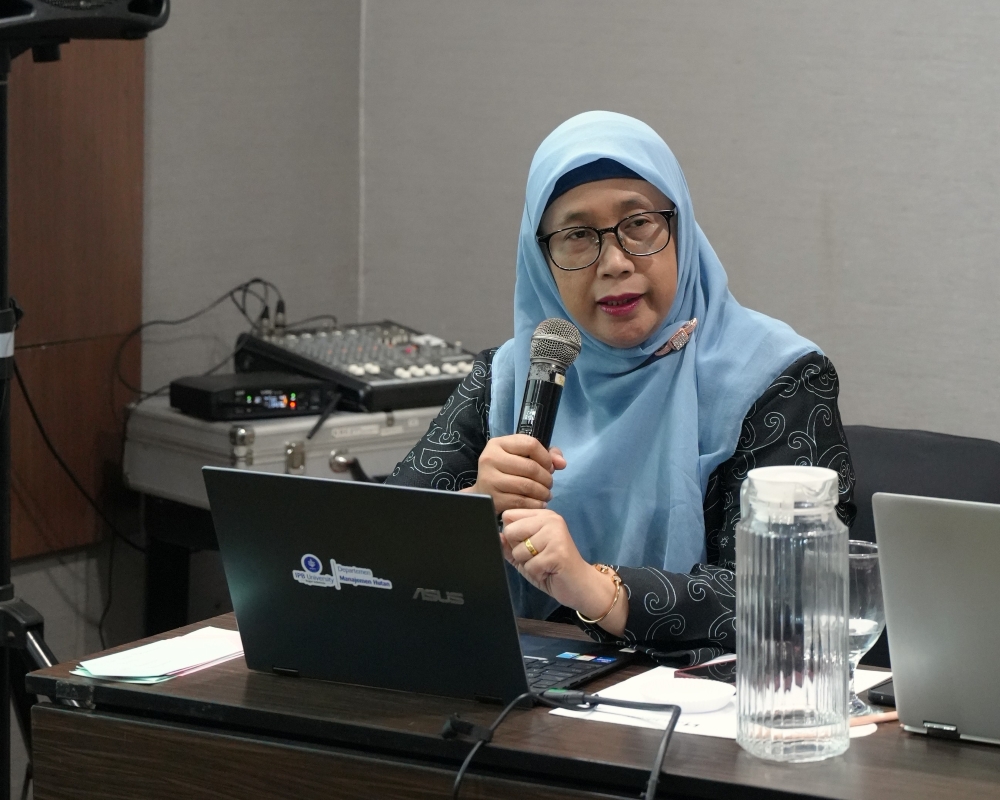
Dr. Ir. Leti Sundawati selaku pemateri utama dalam pelatihan calon pelatih kelembagaan. Sumber foto: KPSHK.
Banyak pengalaman muncul. “Selama ini kami mengejar administrasi, belum kuat ke arah pengelolaan,” ujar Rokhmond Onasis, salah satu peserta. Diskusi lalu bergerak ke arah perbaikan yang mencakup struktur kelembagaan, aturan, dan arah kerja lembaga.
Topik lain yang menghangatkan suasana pelatihan adalah materi kemitraan, terutama menyangkut substansi dan konsep kemitraan yang dijalankan. “Kemitraan bukan atasan dan bawahan, tetapi posisi setara,” Dr. Ir. Leti Sundawati, sebagai pemateri utama, menekankan hal penting ini.
Menanggapi lontaran tersebut, peserta merefleksikan cerita dan pengalaman yang terjadi selama proyek berlangsung. Risiko kontrak tunggal juga muncul dalam diskusi. Peserta mulai memahami pentingnya kesepakatan tertulis dan pembagian peran yang jelas.
Topik lain yang menjadi perhatian penting adalah keberadaan Kelompok Usaha Perhutanan Sosial (KUPS) dan hubungannya dengan LPHD. Pembahasan masalah ini cukup memancing dialog dan diskusi panjang. Beberapa peserta mengakui adanya jarak koordinasi. “Kadang KUPS berjalan sendiri,” ucap Yunita. Setelah mulai menemukan titik terang, ke depan tim lapangan bersama LPHD dan KUPS akan memperbaiki relasi dan penguatan pengelolaan.
Topik hangat hari kedua bergerak ke arah usaha hutan desa. Pemetaan potensi dilakukan melalui simulasi. Rotan, madu, damar, dan hasil hutan bukan kayu lain masuk dalam daftar. Peserta mencoba menghitung volume, musim panen, serta akses lokasi. “Kami baru sadar data usaha harus lengkap,” ujar Cindyani, salah satu peserta.
Analisis kelayakan usaha kemudian diperkenalkan. Pasar, teknis, lingkungan, kelembagaan, dan modal menjadi lima aspek utama. Diskusi berkembang saat contoh madu dan rotan dibahas. “Permintaan madu tinggi, tetapi panen harus menjaga keberlanjutan,” kata Rokhmond Onasis. Peserta lain menambahkan pengalaman lapangan terkait bahan baku rotan.
Manajemen keuangan menjadi sesi yang menarik perhatian. Buku kas, catatan produksi, dan laporan penjualan dibahas satu per satu. “Catatan yang rapi membuat lembaga lebih dipercaya,” jelas Dr. Ir. Leti Sundawati. Peserta mulai menyusun gambaran sistem keuangan yang dapat diterapkan.
Sesi fasilitasi membawa suasana berbeda. Peserta tidak lagi duduk dan berdiskusi. Simulasi micro-teaching berjalan bergantian. Setiap orang mencoba memandu diskusi. “Fasilitator membantu proses belajar, bukan hanya berbicara,” kata Dr. Ir. Leti Sundawati saat memberi umpan balik. Abdul Azis, peserta lain, menanggapi, “Ternyata mendengar aktif itu sulit, tetapi penting.” Komunikasi menjadi kunci dalam sesi ini. Kontak mata, mendengar tanpa memotong, serta merespons inti pesan dilatih langsung. Hambatan komunikasi juga dibahas melalui pengalaman peserta.
Akhir pelatihan ditutup dengan penyusunan rencana tindak lanjut. Peserta menyusun langkah konkret. Penguatan AD/ART, tata kelola hutan, dan usaha menyusul pada tahap berikutnya. Jadwal implementasi disepakati bersama hingga awal tahun berikutnya. “Setelah ini kami langsung bekerja,” ujar Rokhmond Onasis saat penutupan. Kalimat itu menggambarkan arah pelatihan: bukan berhenti pada ruang belajar, tetapi bergerak menuju praktik lapangan.
Dua hari pelatihan meninggalkan catatan penting. Pengetahuan bertemu pengalaman, diskusi melahirkan kesepakatan, dan rencana berubah menjadi langkah nyata.
Penulis: Alma
Editor: JW dan Kiss
Laughter erupted throughout the simulation session. Participants took turns taking the role of facilitator. Flipcharts were spread out, markers were exchanged, and ideas flowed continuously. The two-day Training of Trainers (ToT) for village forest institutions proceeded at a lively pace.
This training aimed to provide a foundation for further strengthening the role of Village Forest Management Institutions (LPHD) in managing village forests. In this regard, an interesting discussion topic following the presentation was a review of the LPHD’s Articles of Association and Bylaws (AD/ART). The AD/ART is the primary foundation for LPHD operations.
Dr. Ir. Leti Sundawati was the main speaker in the training for prospective institutional trainers. Photo source: KPSHK.
Many experiences emerged. “We’ve been focused on administration, but haven’t been strong enough in management,” said Rokhmond Onasis, one of the participants. The discussion then moved on to improvements encompassing the institutional structure, regulations, and direction of the institution’s work.
Another topic that enlivened the training was partnerships, particularly concerning the substance and concept of the partnerships being implemented. “Partnership is not about superiors and subordinates, but about equal positions,” Dr. Ir. Leti Sundawati, the main speaker, emphasized this important point.
In response to this statement, participants reflected on stories and experiences that occurred during the project. The risks of single contracts also emerged in the discussion. Participants began to understand the importance of written agreements and clear role divisions.
Another topic of significant concern was the existence of Social Forestry Business Groups (KUPS) and their relationship with the Village-Owned Forest Management Units (LPHD). Discussion of this issue sparked considerable dialogue and lengthy discussion. Several participants acknowledged a lack of coordination. “Sometimes KUPS operates independently,” said Yunita. Having begun to find clarity, the field team, along with the LPHD and KUPS, will work to improve relationships and strengthen management.
The second day’s hot topic shifted to village forestry businesses. Potential mapping was conducted through simulations. Rattan, honey, resin, and other non-timber forest products were included. Participants attempted to calculate volume, harvest seasons, and site access. “We just realized we need complete business data,” said Cindyani, one of the participants.
A business feasibility analysis was then introduced. Market, technical, environmental, institutional, and capital were the five main aspects. The discussion evolved as examples of honey and rattan were discussed. “Honey demand is high, but harvesting must be sustainable,” said Rokhmond Onasis. Other participants added field experiences related to rattan raw materials.
Financial management was a particularly engaging session. Cash books, production records, and sales reports were discussed one by one. “Neat records make an institution more credible,” explained Dr. Ir. Leti Sundawati. Participants began to develop a picture of a financial system that could be implemented.
The facilitation session brought a different atmosphere. Participants no longer sat and discussed. Micro-teaching simulations took turns, with each participant trying to guide the discussion. “The facilitator facilitates the learning process, not just talking,” said Dr. Ir. Leti Sundawati when providing feedback. Abdul Azis, another participant, responded, “It turns out active listening is difficult, but important.” Communication was key in this session. Eye contact, listening without interrupting, and responding directly to the main message were practiced. Communication barriers were also discussed through the participants’ experiences.
The training concluded with the development of a follow-up plan. Participants developed concrete steps. Strengthening the Articles of Association (AD/ART), forest governance, and business activities followed in the next phase. An implementation schedule was mutually agreed upon for early the following year. “After this, we’ll get straight to work,” said Rokhmond Onasis at the closing ceremony. This statement illustrates the direction of the training: not just in the classroom, but moving towards practical fieldwork.
The two days of training left a significant impact. Knowledge met experience, discussions led to agreements, and plans transformed into concrete actions.
Writer: Alma
Editors: JW and Kiss
Add a Comment