
Pagi masih basah oleh embun ketika langkah-langkah itu mulai menyusuri jalur setapak di hutan desa. Rumput liar yang tumbuh cepat di tanah gambut tampak menutupi sebagian akses menuju menara pantau. Di kejauhan, suara burung bersahut-sahutan, seolah menyambut aktivitas yang hari itu kembali dilakukan: merawat, menjaga, dan memastikan apa yang telah dibangun tetap berfungsi.
Wilayah Hutan Desa di Kecamatan Kahayan Hilir menyimpan cerita panjang tentang upaya menjaga ekosistem gambut. Bukan hanya soal membangun sekat kanal atau menara pantau, tetapi juga kerja-kerja sunyi yang sering luput dari perhatian perawatan infrastruktur yang menjadi tulang punggung perlindungan hutan.
Program Inisiatif Kahayan Hilir yang dijalankan oleh KPSHK telah memasuki tahun Kelima. Infrastruktur seperti menara pantau, sumur bor, hingga pondok kerja telah hadir sejak awal program. Namun, waktu dan kondisi alam membuat semuanya membutuhkan perhatian berkelanjutan. “Sering kali orang melihat pembangunan sebagai hasil akhir. Padahal, justru tantangan sebenarnya adalah bagaimana memastikan itu tetap berfungsi dalam jangka panjang,” ujar Bayu, GIS & Database Manager KPSHK.
Pemandangan itu terlihat jelas di salah satu menara pantau. Tagap, Masyarakat Kalawa berdiri di ketinggian 17 meter, kuas di tangan, melapisi ulang cat berwarna merah cerah pada rangka menara. Setiap sapuan dilakukan perlahan, memastikan seluruh permukaan terlindungi dari panas dan hujan yang terus menggerus. Sisi lain di Mantaren I, Andre sibuk mengencangkan baut-baut yang mulai kendur memutar kunci dengan hati-hati agar struktur tetap kokoh dan aman digunakan. Ember cat tergantung di sisi tangga, menjadi saksi kerja-kerja detail yang jarang terlihat, tetapi sangat menentukan.
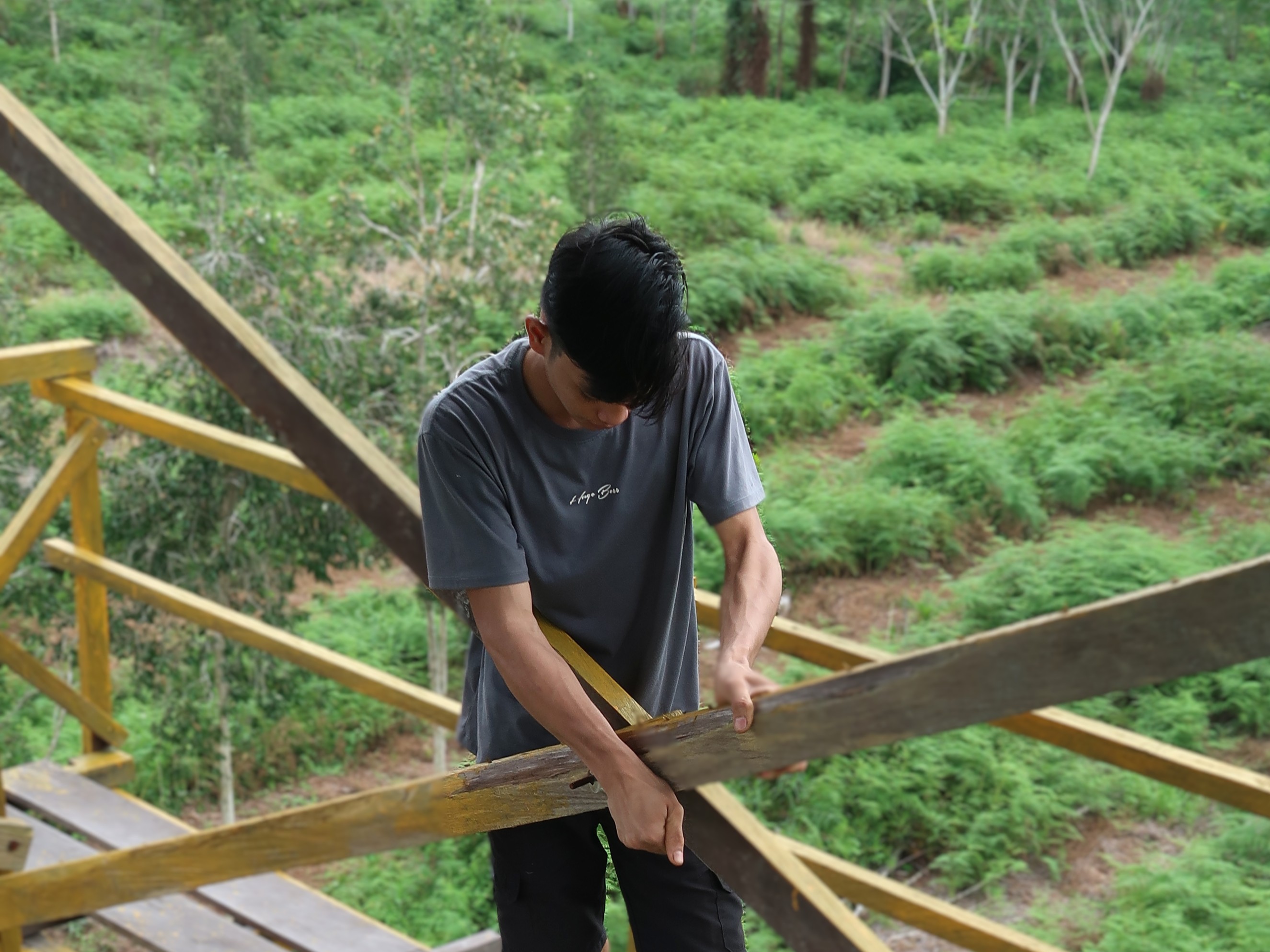 Pengencangan baut Menara Pantau di Mantaren I. Sumber foto: KPSHK.
Kondisi lapangan menunjukkan bahwa perawatan bukan pekerjaan sepele. Baut-baut menara yang mulai mengendur perlu dikencangkan kembali. Karat pada beberapa bagian harus dicegah melalui pelumasan dan pengecatan ulang. Rumput liar di sekitar sumur bor dan pondok kerja juga harus dibersihkan agar akses tetap terbuka.
Bagi Masyarakat dan tim patroli, pekerjaan ini bukan sekadar rutinitas teknis. Upaya ini menjadi bagian penting dalam mencegah risiko yang lebih besar kebakaran hutan dan lahan. “Kalau sumur bor tidak dirawat, nanti saat dibutuhkan justru tidak bisa dipakai. Begitu juga dengan menara pantau, kalau tidak aman, orang juga tidak berani naik untuk memantau,” kata Ganti, salah satu anggota tim patroli.
Langkah mereka menyusuri titik demi titik infrastruktur yang tersebar di empat wilayah LPHD. Terik matahari maupun genangan air gambut tidak menghentikan pekerjaan. Setiap fasilitas dipastikan tetap siap digunakan kapan saja.
Bayu melihat kerja ini sebagai bagian penting dari menjaga keberlanjutan program. “Perawatan ini mungkin terlihat sederhana, tapi dampaknya besar. Infrastruktur yang terawat berarti kesiapsiagaan kita juga terjaga, terutama dalam menghadapi ancaman karhutla,” ungkapnya.
Wilayah ini bukan tanpa sejarah. Kebakaran besar pada tahun 2015, 2019, dan 2023 masih membekas dalam ingatan masyarakat. Api tidak hanya menghanguskan hutan, tetapi juga merusak fungsi ekologis gambut yang sangat penting.
Karena itu, setiap baut yang dikencangkan, setiap lapisan cat yang diperbarui, hingga setiap sumur yang dikuras, menjadi bagian dari upaya panjang memulihkan dan melindungi ekosistem.
Sela-sela pekerjaan kerap dimanfaatkan tim patroli untuk beristirahat sejenak sebelum kembali melanjutkan tugas. Tidak ada sorotan kamera, tidak ada panggung. Namun, dari kerja-kerja kecil itulah sistem perlindungan hutan tetap berjalan. “Kadang orang tidak tahu kami melakukan ini. Tapi kami tahu, kalau tidak dirawat, semuanya bisa rusak dan tidak bisa dipakai saat kondisi darurat,” ujar Ganti.
Menjelang siang, menara pantau kembali berdiri kokoh. Cat tampak segar, baut kembali kencang, dan struktur siap digunakan. Perubahan mungkin tidak mencolok bagi orang luar, tetapi bagi mereka yang memahami, kondisi ini menjadi tanda bahwa sistem masih bekerja.
Tantangan perubahan iklim dan ancaman kebakaran terus mengintai. Menjaga yang sudah ada menjadi sama pentingnya dengan membangun yang baru.
Hutan gambut Kahayan Hilir terus menyimpan harapan melalui tangan-tangan yang merawat, menjaga, dan memastikan hutan tetap memiliki masa depan.
Penulis: Alma
The morning was still damp with dew as they began their journey along the path through the village forest. Fast-growing weeds on the peat soil partially obscured access to the watchtower. In the distance, birdsong echoed, as if welcoming the return of the day’s activities: caring for, maintaining, and ensuring the continued functioning of what had been built.
The Village Forest area in Kahayan Hilir District holds a long history of efforts to preserve the peat ecosystem. It’s not just about building canal barriers and watchtowers, but also the quiet work that often goes unnoticed: the maintenance of the infrastructure that forms the backbone of forest protection.
The Kahayan Hilir Initiative Program, run by the Forest Management Unit (KPSHK), has entered its fifth year. Infrastructure such as watchtowers, drilled wells, and work huts have been in place since the program’s inception. However, time and natural conditions mean that all of this requires ongoing attention. “People often view development as the end result. However, the real challenge is how to ensure it remains functional in the long term,” said Bayu, GIS & Database Manager at KPSHK.
This view is clearly visible from one of the watchtowers. In Tagap, a Kalawa community member stands 17 meters tall, brushes in hand, re-coating the bright red paint on the tower’s frame. Each stroke is done slowly, ensuring the entire surface is protected from the eroding heat and rain. On the other side of Mantaren I, Andre is busy tightening loose bolts, carefully turning the wrench to ensure the structure remains sturdy and safe to use. A paint bucket hangs from the side of the ladder, testifying to the detailed work that is rarely seen, but crucial.
Tightening the bolts on the observation tower at Mantaren I. Photo source: KPSHK.
Field conditions demonstrate that maintenance is no trivial task. Loosened tower bolts need to be re-tightened. Rust on some parts must be prevented through lubrication and repainting. Weeds around the drilled well and work hut must also be cleared to maintain open access.
For the community and the patrol team, this work is more than just a technical routine. It is a crucial part of preventing the greater risk of forest and land fires. “If the boreholes aren’t maintained, they won’t be usable when needed. The same goes for watchtowers; if they’re not safe, people won’t dare go up to monitor them,” said Ganti, a member of the patrol team.
They walked point by point along the infrastructure spread across the four LPHD areas. Neither the scorching sun nor the peat puddles stopped the work. Every facility was guaranteed to remain ready for use at any time.
Bayu sees this work as a crucial part of maintaining the program’s sustainability. “This maintenance may seem simple, but it has a significant impact. Maintained infrastructure means our preparedness is maintained, especially in the face of the threat of forest and land fires,” he said.
This region is not without history. Major fires in 2015, 2019, and 2023 are still fresh in the community’s memory. The fires not only scorched the forest but also damaged the vital ecological function of the peat.
Therefore, every bolt tightened, every coat of paint renewed, and every well drained is part of a long-term effort to restore and protect the ecosystem.
The patrol team often takes breaks from work to take a break before resuming their duties. There are no cameras, no stage. Yet, these small tasks keep the forest protection system running. “Sometimes people don’t know we’re doing this. But we know that if not maintained, everything can be damaged and unusable in an emergency,” said Ganti.
By midday, the watchtower was standing strong again. The paint looked fresh, the bolts were tightened, and the structure was ready for use. The changes may not be noticeable to outsiders, but to those who understand, these conditions are a sign that the system is still working.
The challenges of climate change and the threat of fire continue to lurk. Preserving what already exists is just as important as building new.
The Kahayan Hilir peat forest continues to hold hope through the hands that care for, protect, and ensure the forest’s future.
Writer: Alma
Editor: JW & Kiss
Add a Comment