
Bagi warga Kelurahan Kalawa, Kabupaten Pulang Pisau, Kalimantan Tengah, kebakaran hutan dan lahan (karhutla) mengancam lingkungan sekaligus kebun yang menjadi sumber penghidupan. Saat musim kemarau membuat air handil surut, akses menuju kebun dan ketersediaan air untuk pembasahan menjadi tantangan.

Kebakaran hutan dan lahan di Kalawa. (KPSHK, 2026).
Nunu Rulianto, pemilik kebun di Handel Bangkalung 1 dan Bangkalung 2, pernah ikut membantu pemadaman kebakaran di kawasan antara Handel Buluh dan Sungai Meikei. Setelah menerima informasi sekitar pukul 15.00, ia bergabung dengan Masyarakat Peduli Api (MPA), Lembaga Pengelola Hutan Desa (LPHD), dan tim pos lapangan. Api diperkirakan membakar sekitar 25 hektare lahan. Pemadaman berlangsung hingga pagi.
Nunu khawatir api merambat ke kebunnya yang terdiri atas tiga hektare kebun karet, satu hektare kelapa sawit, serta lahan dengan berbagai tanaman lainnya. “Kalau api merembet dan makin membesar, sulit untuk pemadaman dan bisa melalap kebun kita,” ujarnya.
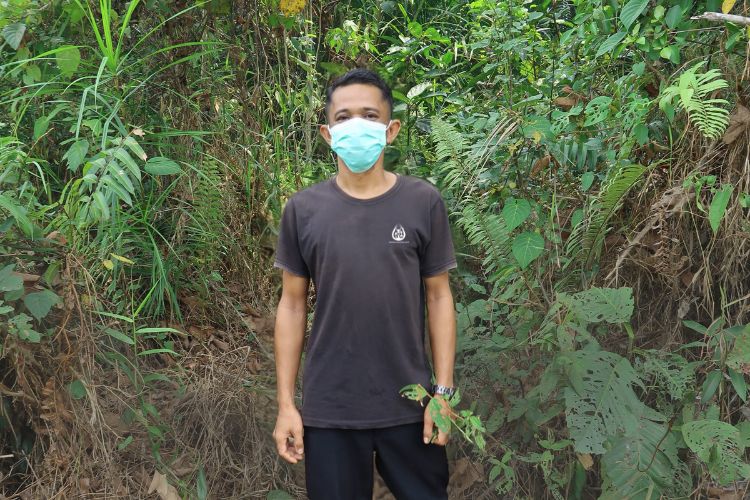
Nunu, pemilik kebun masyarakat Kalawa. (KPSHK, 2026).
Untuk mengantisipasi kebakaran, Nunu membersihkan batas kebun dan menyiapkan mesin pompa serta selang untuk pembasahan. Namun, upaya tersebut bergantung pada ketersediaan air yang semakin terbatas saat kemarau.
Sumur Bor untuk Mendukung Pembasahan
Rahmat Lamak Ganti, warga Kalawa yang aktif dalam Kelompok Tani Hutan (KTH), merasakan sulitnya mengakses kebun ketika air handil surut. Warga yang mengandalkan jalur air untuk bekerja harus menghadapi kondisi perairan yang cepat berubah. “Masih ada air, tetapi hanya sejengkal,” kata Rahmat.
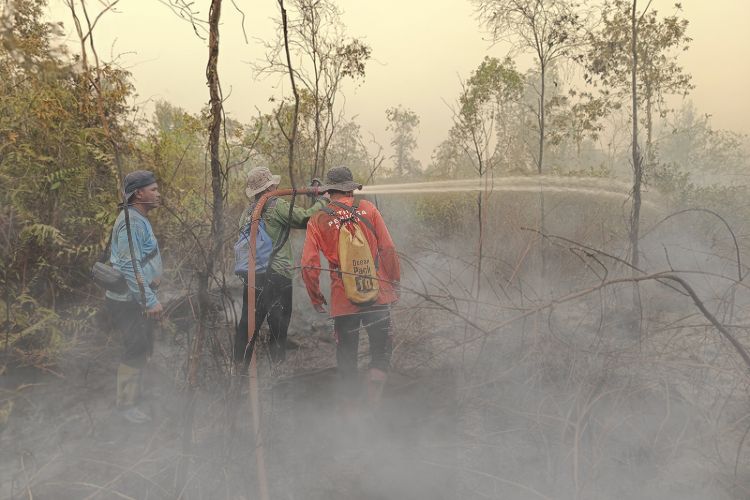
Pemadaman kebakaran oleh TDK di HD Kalawa. (KPSHK, 2026).
Kondisi tersebut menyulitkan perjalanan menggunakan perahu bermotor sekaligus membatasi akses menuju sumber air untuk pembasahan. Karena itu, sumur bor menjadi salah satu sarana penting bagi warga.
KTH yang dikelola Rahmat memiliki dua sumur bor yang masih berfungsi karena dirawat secara rutin. Fasilitas tersebut membantu kelompok menyediakan air untuk membasahi lahan. “Sumur bor sangat membantu. Tanaman yang gersang kalau dibasahi berbeda kondisinya. Debu juga berkurang,” jelasnya.
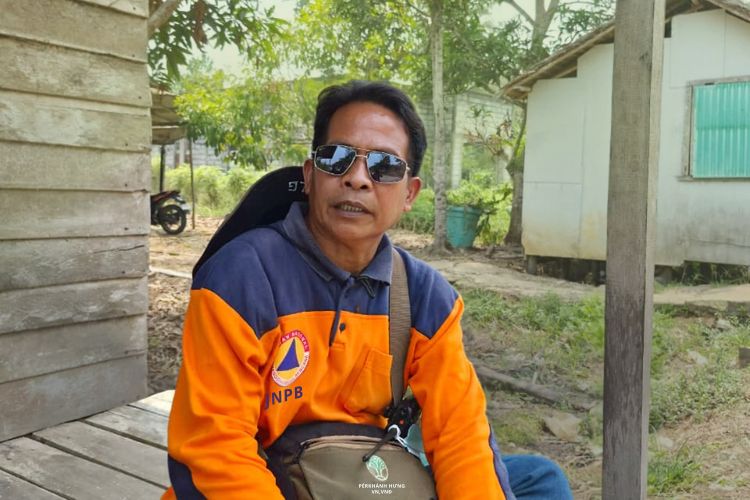
Rahmat Lamak Ganti, warga Kalawa yang aktif dalam Kelompok Tani Hutan (KTH). (KPSHK, 2026).
Kebutuhan sumber air di kawasan kebun masih cukup besar. Rahmat mengusulkan agar sumur bor ditempatkan lebih dekat dengan lahan, dengan jarak sekitar 500 meter hingga satu kilometer antartitik, menyesuaikan kondisi wilayah. Sementara itu, Nunu memperkirakan kawasan Sungai Bangkalung membutuhkan sekitar 50 titik sumur bor. Menurutnya, empat titik yang tersedia di Sungai Bangkalung 2 dari bantuan BPBD belum mencukupi kebutuhan kawasan.
Menjaga Kebun, Menjaga Bersama
Selain ketersediaan air, akses menuju kebun, kesiapan peralatan, dan koordinasi antarkelompok juga menentukan efektivitas penanganan karhutla. Nunu mengingat bagaimana personel yang sebelumnya membantu penanganan kebakaran di Gohong harus kembali ke Kalawa ketika titik api muncul di wilayah tersebut. Situasi ini menunjukkan pentingnya pembagian tenaga agar penanganan dapat berlangsung secara berkelanjutan.
Nunu menyatakan kesediaannya merawat sumur bor apabila fasilitas tersebut dibangun di sekitar kawasan kebun melalui program Inisiatif Kahayan Hilir (IKH) yang diinisiasi KPSHK bersama LPHD. “Dari dulu kita siap merawat sumur bor. Itu kepentingan kita juga sehari-hari,” katanya.
Bagi warga Kalawa, sumur bor bukan sekadar fasilitas pemadaman, melainkan bagian dari upaya melindungi kebun dan penghidupan. Pengalaman menghadapi kebakaran mengingatkan mereka bahwa kesiapsiagaan perlu dibangun sebelum api meluas, melalui sumber air yang memadai, peralatan yang siap digunakan, dan kerja sama masyarakat.
Penulis: Alma
For the residents of Kalawa Village, Pulang Pisau Regency, Central Kalimantan, forest and land fires pose a threat to both the environment and the plantations that serve as their primary source of livelihood. During the dry season, as water levels in the *handil* (traditional irrigation canals) recede, accessing these plantations and securing enough water to dampen the land becomes a significant challenge.
Forest and land fires in Kalawa. (KPSHK, 2026).
Nunu Rulianto, who owns plantations in the areas of Handel Bangkalung 1 and Bangkalung 2, once assisted in firefighting efforts in the region between Handel Buluh and the Meikei River. Upon receiving an alert around 3:00 PM, he joined the Fire-Aware Community (MPA), the Village Forest Management Institution (LPHD), and a field post team. The fire is estimated to have consumed approximately 25 hectares of land. Extinguishing efforts continued until the following morning.
Nunu expressed concern that the fire might spread to his own plantations, which include three hectares of rubber trees, one hectare of oil palms, and other cultivated crops. “If the fire spreads and grows larger, it becomes difficult to extinguish, and it could end up consuming our plantations,” he said.
Nunu, a plantation owner from the Kalawa community. (KPSHK, 2026).
To prepare for potential fires, Nunu clears the boundaries around his plantations and keeps water pumps and hoses ready for dampening the land. However, the effectiveness of these measures depends on the availability of water, which becomes increasingly scarce during the dry season.
Boreholes to Support Land Wetting
Rahmat Lamak Ganti, a resident of Kalawa who is active in a Forest Farmer Group (KTH), experiences the difficulty of accessing his farm when the water level in the *handil* (traditional canal) drops. Residents who rely on these waterways for their work must contend with rapidly fluctuating water conditions. “There is still some water, but it’s only about a handspan deep,” says Rahmat.
Fire suppression efforts by the TDK (Fire Response Team) in the Kalawa Village Forest (HD Kalawa). (KPSHK, 2026).
Such conditions hinder travel by motorized boat and limit access to water sources needed for wetting the land. Consequently, boreholes have become a vital resource for the residents.
The KTH managed by Rahmat has two functional boreholes, which remain operational thanks to regular maintenance. These facilities help the group secure water to wet the land. “The boreholes are a huge help. Parched plants look completely different once they’ve been watered. It also reduces the dust,” he explains.
Rahmat Lamak Ganti, a resident of Kalawa who is active in a Forest Farmer Group (KTH). (KPSHK, 2026).
There remains a significant need for water sources in the farming areas. Rahmat suggests placing boreholes closer to the fields—spaced roughly 500 meters to one kilometer apart—depending on local terrain conditions. Meanwhile, Nunu estimates that the Sungai Bangkalung area requires approximately 50 borehole sites. According to him, the four points provided at Sungai Bangkalung 2—supplied through assistance from the BPBD—are insufficient to meet the area’s needs.
Protecting Gardens, Protecting Together
Beyond water availability, access to gardens, the readiness of equipment, and coordination between groups are all critical factors in the effectiveness of forest and land fire management. Nunu recalls how personnel who had been assisting with fire suppression in Gohong had to return to Kalawa when new hotspots emerged there. This situation highlights the importance of distributing human resources to ensure that fire response efforts can be sustained over time.
Nunu expressed his willingness to maintain a borehole—should one be constructed near the garden area through the Kahayan Hilir Initiative (IKH), a program launched by KPSHK in collaboration with the Village Forest Management Institution (LPHD). “We have always been ready to look after a borehole. It serves our own daily needs as well,” he said.
For the residents of Kalawa, a borehole is more than just a firefighting facility; it is an essential part of protecting their gardens and their livelihoods. Their experience in dealing with fires has taught them that preparedness must be established before a blaze spreads—through access to adequate water sources, equipment that is ready for use, and strong community cooperation.
Author: Alma
Add a Comment