
Beranda rumah kayu yang teduh di Desa Gohong menjadi ruang tempat suara gesekan rotan menghadirkan irama yang menenangkan. Pagi itu, Marlinie duduk bersila bersama beberapa perempuan lain, jemari mereka cekatan menyusun helai demi helai rotan menjadi bentuk yang perlahan hidup topi, tas, tikar, dan berbagai kerajinan lain yang tak sekadar indah, tetapi juga menyimpan nilai ekonomi dan budaya.
Sebagai ketua Kelompok Usaha Perhutanan Sosial (KUPS) Rotan di bawah naungan Lembaga Pengelola Hutan Desa (LPHD) Gohong, Marlinie tak hanya menganyam rotan, tetapi juga merajut harapan bagi kelompoknya. “Anyaman rotan ini bukan sekadar kerajinan, tapi sudah jadi sumber penghasilan utama bagi kami di desa,” ujarnya sambil terus menggerakkan tangannya tanpa jeda.
Di sampingnya, Inova, salah satu anggota KUPS tampak fokus menyusun pola pada sebuah tas kecil bermotif khas. Baginya, kegiatan ini bukan hal baru, melainkan bagian dari keseharian yang telah ia jalani sejak lama. “Kalau lagi banyak pesanan, kami bisa kerja hampir seharian. Tapi hasilnya memang terasa membantu ekonomi keluarga,” katanya singkat, matanya tetap tertuju pada anyaman yang belum rampung.
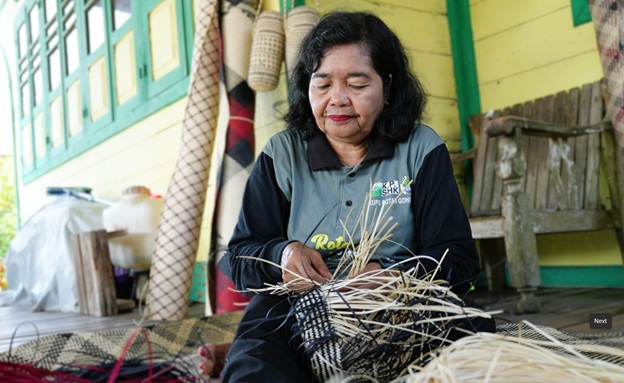
Marlinie Ketua KUPS Rotan LPHD Gohong. Sumber foto: KPSHK.
Produksi anyaman rotan di Desa Gohong kini berkembang menjadi salah satu potensi ekonomi yang menjanjikan. Berbekal bahan baku dari hutan sekitar dan keterampilan yang diwariskan turun-temurun, kelompok ini mampu menghasilkan produk bernilai jual tinggi, bahkan mulai menjangkau pasar yang lebih luas. Motif-motif yang dihasilkan bukan sekadar estetika, tetapi juga identitas lokal yang tak tergantikan.
Namun, di balik geliat tersebut, tantangan tak bisa dihindari. Ketersediaan bahan baku rotan mulai terasa tidak menentu, seiring perubahan kondisi hutan dan tekanan lingkungan. Selain itu, minat generasi muda untuk melanjutkan tradisi menganyam juga semakin berkurang. “Anak-anak muda sekarang banyak yang lebih memilih kerja lain. Padahal kalau ditekuni, anyaman rotan ini bisa jadi masa depan,” ungkap Marlinie dengan nada harap.
Walau berbagai tantangan terus hadir, upaya untuk menjaga keberlanjutan tradisi ini tetap berjalan. Program Inisiatif Kahayan Hilir (IKH) turut mendorong keterlibatan generasi muda agar tetap mengingat dan mewariskan keterampilan menganyam melalui berbagai pelatihan yang telah dilaksanakan di desa. Tidak hanya itu, KPSHK juga berperan dalam memperluas akses pasar dengan memfasilitasi promosi produk anyaman rotan melalui keikutsertaan dalam expo dan pameran di Palangka Raya, membuka peluang lebih besar bagi produk lokal untuk dikenal luas.
Semangat para perempuan di Gohong pun tak surut. Setiap helai rotan yang mereka anyam menjadi simbol ketahanan bukan hanya untuk menjaga tradisi, tetapi juga untuk memastikan bahwa hutan tetap memberi kehidupan. Di tangan mereka, rotan tak hanya berubah bentuk, tetapi juga menjelma menjadi cerita tentang keberlanjutan, kemandirian, dan harapan yang terus dianyam, hari demi hari.
Penulis: Alma
Editor: JW dan Kiss
The shady veranda of a wooden house in Gohong Village is a space where the sound of rattan rubbing creates a soothing rhythm. That morning, Marlinie sat cross-legged with several other women, their fingers deftly arranging strand by strand of rattan into the slowly coming to life of hats, bags, mats, and various other crafts that are not only beautiful but also hold economic and cultural value.
As the head of the Rattan Social Forestry Business Group (KUPS) under the auspices of the Gohong Village Forest Management Institution (LPHD), Marlinie not only weaves rattan but also weaves hope for her group. “This rattan weaving is not just a craft, but has become our main source of income in the village,” she said, her hands constantly moving.
Beside her, Inova, a KUPS member, was focused on arranging patterns on a small bag with a distinctive motif. For her, this activity is nothing new, but rather a part of her daily life that has long been a part of her life. “When we have lots of orders, we can work almost all day. But the results really do help the family’s finances,” she said briefly, her eyes fixed on the unfinished weaving.
Marlinie, Chairperson of the Gohong Village Rattan Weaving Unit (KUPS Rattan LPHD). Photo source: KPSHK.
Rattan weaving production in Gohong Village has now developed into a promising economic opportunity. Using raw materials from the surrounding forest and skills passed down through generations, this group is able to produce high-value products and is even reaching a wider market. The resulting motifs are not merely aesthetic but also represent an irreplaceable local identity.
However, despite this growth, challenges are unavoidable. The availability of raw rattan is becoming increasingly uncertain, in line with changing forest conditions and environmental pressures. Furthermore, the younger generation’s interest in continuing the weaving tradition is also decreasing. “Many young people now prefer other jobs. But if they pursue it, rattan weaving could be a future,” Marlinie said hopefully.
Despite these challenges, efforts to maintain the sustainability of this tradition continue. The Kahayan Hilir Initiative (IKH) program encourages the involvement of the younger generation to preserve and pass on weaving skills through various training sessions held in the village. Furthermore, the KPSHK (Indonesian Community Welfare Association) also plays a role in expanding market access by facilitating the promotion of woven rattan products through participation in expos and exhibitions in Palangka Raya, opening up greater opportunities for local products to gain wider exposure.
The women of Gohong are unwavering in their enthusiasm. Each strand of rattan they weave is a symbol of resilience, not only preserving tradition but also ensuring that the forest continues to provide life. In their hands, the rattan not only changes shape but also transforms into a story of sustainability, independence, and hope, which continues to be woven day after day.
Writer: Alma
Editors: JW and Kiss
Add a Comment