
Matahari belum tinggi di Desa Gohong, Kecamatan Kahayan Hilir, Kalimantan Tengah. Namun penghuni, jajaran rumah-rumah panggung di tepian Sungai Kahayan sudah mulai beraktivitas. Warga mulai bergerak. Sebagian menuju kebun, sebagian membawa hasil panen. Setiap orang mengayun langkah dan menyusuri jalur masing-masing.
Sayang, perempuan berusia 54 tahun, warga Desa Gohong, mulai melangkah meninggalkan rumahnya sambil menjinjing ember. Heron, warga Desa Gohong lainnya, bersiap memacu ces yang ditambatkan di tiang rumahnya. Dengan lincah ia mengemudikan perahu kecil itu berkelok menyusuri kanal-kanal handil menuju kebun. Laju ces meninggalkan riak air sepanjang jalur dan persimpangan yang telah ia kenali setiap sudutnya. “Kalau sudah tahu jalurnya, tidak akan tersesat,” katanya.
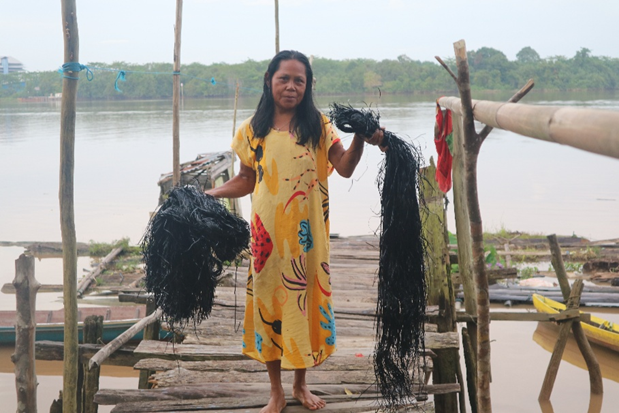 Ibu Sayang (54), warga Desa Gohong, berpose dengan bahan anyaman rotan
yang telah selesai diwarnai. Sumber foto: KPSHK.
Sesampai di kebun, Heron menambatkan ces, dan mulai melangkah menyusuri tanah gambut. Sesekali ia berhenti, menyentuh tanah lalu membuka lapisan atas. Membaca tanah adalah bagian dari keseharian masyarakat saat melaluinya. “Kalau terasa hangat, kami langsung cek lagi,” ujarnya.
Memasuki siang, aktivitas terhenti. Mereka berkumpul di kebun dekat kanal melepas lelah. Tatapan mereka juga tak pernah lepas dari air kanal yang terlihat tenang sambil mengamati batang kayu di kanal sebagai acuan tinggi muka air. “Kalau air turun, tanah cepat berubah,” kata Yudi. Jika ini terjadi berarti tandanya untuk melihat dan menata kembali sekat kanal untuk mempertahankan tinggi muka air.
Air menentukan banyak hal. Air menjaga tanah agar lahan gambut tetap aman. Saat air turun, pijakan berubah dan genangan hilang. Pada situasi seperti ini, warga segera memeriksa lahan dan mengenali tanda awal perubahan.
Menjaga gambut sudah menjadi bagian dari kehidupan. Warga menjaga air agar tanah tetap menyimpan cadangan. “Kalau tanah ini berubah, hidup kami ikut berubah,” kata Sayang.
Penulis: Alma
Editor: Kiss & JW
The sun wasn’t yet high in Gohong Village, Kahayan Hilir District, Central Kalimantan. However, the residents of the rows of stilt houses along the banks of the Kahayan River were already bustling about. Residents were starting to move. Some were heading to their gardens, others were carrying their harvest. Everyone was moving, following their own paths.
Sayang, a 54-year-old woman from Gohong Village, began to leave her house carrying a bucket. Heron, another resident of Gohong Village, prepared to speed up the ces (traditional fishing boat) moored to a pole in her house. He nimbly steered the small boat, winding its way along the canals toward the garden. The ces’ speed left ripples along the paths and intersections, every corner of which he knew. “If you know the way, you won’t get lost,” he said.
Ibu Sayang (54), a resident of Gohong Village, poses with rattan
woven material that has been dyed. Photo source: KPSHK.
Upon reaching the garden, Heron tied the ces (traditional fishing boat) and began walking along the peat soil. Occasionally, he stopped, touched the soil, and then removed the top layer. Reading the soil is part of the community’s daily life as they move through it. “If it feels warm, we immediately check again,” he said.
As the afternoon approaches, activities cease. They gather in the garden near the canal to relax. Their gazes never leave the calm water, observing the logs in the canal as a reference point for the water level. “When the water level drops, the ground changes quickly,” Yudi said. If this happens, it’s a sign to check and rearrange the canal barriers to maintain the water level.
Water determines many things. It holds the soil together, keeping the peatland secure. When the water level drops, the footing changes and the puddles disappear. In situations like this, residents immediately inspect the land and recognize the early signs of change.
Maintaining peat has become a part of life. Residents conserve water so the soil maintains its reserves. “When this land changes, our lives change with it,” Sayang said.
Author: Alma
Editor: Kiss & JW
Add a Comment